
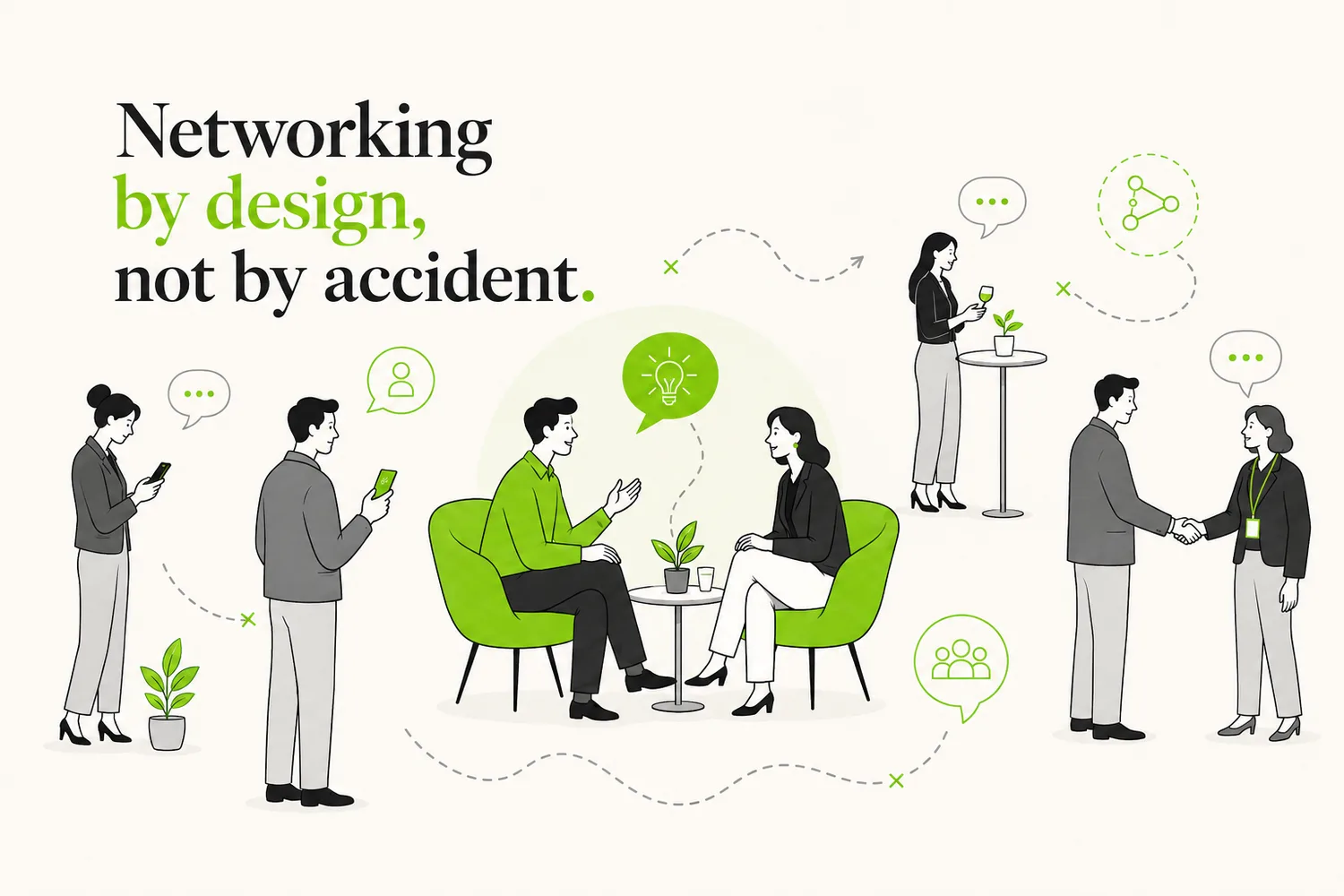
Networking by design starts with a simple idea: meaningful connection should never be left to chance.
Ask almost any event professional what attendees value most about in-person gatherings, and networking will be near the top of the list.
The data backs this up: 83 percent of attendees say networking opportunities directly influence their decision to attend an event in person. Connection is a core part of why people show up.
So why does networking so often feel like the worst part of the day?
The Problem with Traditional Event Networking
Picture the scene. It’s 5:30 pm. The last session has ended. Someone opens a cash bar. A DJ plays at a volume that makes actual conversation difficult. The extroverts drift toward the people they already know, the introverts drift toward the exits, and the majority of attendees spend 45 minutes wondering when it’s acceptable to leave and go back to the quiet of their rooms!
Research from IMEX 2025 signals a significant generational shift in networking expectations. Younger professionals actively dislike traditional mixers and unstructured receptions. They describe them as awkward and unproductive. What they want instead is curated connection — introductions with context, structured conversations with purpose, and networking formats that give them something to actually do.
This shift isn’t a trend to watch. It’s already here.
Why Traditional Networking Fails (And Why It Matters)
The cocktail-hour model doesn’t just fail young professionals. It systematically excludes:
Introverts, who find unstructured social environments draining and often spend more energy managing discomfort than building meaningful connections.
Neurodiverse attendees, for whom loud, unpredictable social environments can be genuinely overwhelming — and who may be your most engaged, thoughtful participants in every other part of the day.
Newcomers and first-time attendees, who haven’t yet built the relationships that make a mixer feel comfortable or safe.
People from underrepresented groups, for whom “networking” often means navigating rooms where they don’t see themselves reflected — and where the unwritten rules of who gets approached are rarely neutral.
If your networking design only works for extroverts and insiders, you’re not designing for your full audience. You’re designing for a fraction of it. And everyone else is just getting through it.
What Does Networking by Design Actually Look Like?
Good news: inclusive, structured networking isn’t a consolation prize for people who can’t handle a mixer. It produces better connections for everyone — more meaningful conversations, more lasting relationships, and higher attendee satisfaction across the board.
Networking by design replaces unstructured interaction with purposeful formats that make connection easier for everyone.
Here are six formats we love:
- Structured conversation starters Give every table or small group a specific question to discuss. Not “Tell us about your work” — something with a bit more spark: “What’s the biggest challenge your team is navigating right now?” or “What’s one thing you wish more people in this industry understood?” A good question removes the social pressure of opening a conversation and immediately creates depth.
- Curated introductions Do the work of making matches before the event. Based on registration data, roles, or interests, suggest three to five specific people each attendee should connect with — and tell them why. “You and Maya are both navigating digital transformation in mid-size associations” is infinitely more useful than a networking app with 300 profiles and no context.
- Topic tables or “birds of a feather” sessions Organize tables around specific themes or challenges. People self-select based on interest, which creates instant common ground. The conversation starts itself — no awkward opener required.
- Connection cards A simple card with three prompts — “I’m working on… / I could use help with… / I can offer…” — turns any coffee break into a structured exchange. Attendees carry them all day. The card does the conversational heavy lifting.
- Peer accountability pairings At the close of the event, pair each attendee with one other person and give them a 30-day check-in prompt. “In 30 days, share one thing you’ve tried from today.” This extends the connection beyond the room, creates accountability, and dramatically increases the likelihood that insights will actually be applied.
- Post-event community spaces A LinkedIn group, Slack channel, or private forum where attendees continue the conversation after the event ends. Facilitated well — with weekly prompts, member spotlights, or speaker Q&As — these communities can sustain the energy of the event for months.
The Inclusion Imperative
Accessible event design now means more than physical access. It means cognitive and sensory inclusion — appropriate lighting, manageable sound levels, clear signage, predictable pacing, and networking formats that don’t require people to perform sociability on command.
When you design networking that works for introverts, neurodiverse attendees, and newcomers, you don’t make it worse for extroverts. You make it richer for everyone. You create the conditions for real connection — the kind people remember, and that keeps them coming back year after year.
A Simple Test for Your Next Event
Here’s a question worth sitting with before you finalize your next networking agenda: could every single person in the room — not just the ones who already know people — leave with at least three meaningful new connections?
If the answer isn’t a clear yes, the design needs work.
Networking is too important — and too often cited as a primary reason people choose to attend in person — to be left to chance and a cash bar. Structured, intentional, inclusive networking design isn’t a nicety. It’s a core part of the experience.
Design it that way.
Continue Exploring Intentional Event Networking
How Curated Networking Activates Event Audiences
Discover how facilitated conversations and structured networking formats turn passive attendees into active participants.
The Forgetting Curve: Why Events Need More Than a Moment
Explore why post-event reinforcement and continued connection are essential for creating lasting event impact.
LimeLight Group designs speaker-led events that create genuine connection for every person in the room, not just the ones who are easy to reach. If you’re ready to rethink how your gatherings bring people together, let’s talk.
Frequently Asked Questions
What is networking by design?
Answer: Networking by design is the intentional planning of networking experiences that encourage meaningful conversations rather than relying on unstructured social interaction. It uses structured formats, curated introductions, and inclusive activities to help attendees build valuable connections.
Why do traditional networking events often fail?
Answer: Traditional networking often relies on informal mixers where attendees are expected to initiate conversations on their own. This approach can be uncomfortable for many people, particularly introverts, newcomers, neurodiverse attendees, and those who don’t already have an established network.
How can event planners improve networking at conferences?
Answer: Event planners can improve networking by incorporating structured conversation starters, curated introductions, topic-based discussion tables, peer accountability pairings, connection cards, and post-event communities that encourage meaningful interaction before, during, and after the event.
Why is inclusive networking important?
Answer: Inclusive networking creates opportunities for all attendees to participate comfortably, regardless of personality, experience, or communication style. Thoughtfully designed networking experiences help foster stronger relationships, increase engagement, and improve the overall event experience.
What are examples of structured networking activities?
Answer: Structured networking activities include guided discussion questions, topic tables, curated attendee introductions, connection cards, peer accountability partnerships, and facilitated post-event communities that encourage ongoing collaboration.
How can networking improve event success?
Answer: Meaningful networking helps attendees exchange ideas, build professional relationships, and continue conversations beyond the event. When networking is intentionally designed, it increases engagement, strengthens attendee satisfaction, and contributes to the long-term value of the event.
What role does networking play in the attendee experience?
Answer: Networking is one of the primary reasons people choose to attend events in person. Creating intentional opportunities for connection helps attendees feel included, engaged, and more likely to return for future events.
How can organizations design more meaningful networking experiences?
Answer: Organizations can create more meaningful networking experiences by planning opportunities that encourage purposeful conversations, support different communication styles, and extend connections beyond the event through follow-up activities and community-building.
Enjoyed this post? Explore more ideas for creating meaningful event experiences.
The Future of Events
How Curated Networking Activates Event Audiences
Great events don’t leave networking to chance. They intentionally create opportunities for people to connect, collaborate, and continue the conversation long after the event ends.
If you’re planning a conference, leadership retreat, or association event and want to create more meaningful audience engagement, explore the LimeLight speaker roster or book a discovery call to discuss your event strategy and networking experience.