
Networking Without the Awkward
For years, networking at conferences followed a familiar pattern: a crowded reception, a drink in hand, and the quiet hope that something useful might happen.
Sometimes it did.
But more often, attendees spoke to the people they already knew, exchanged a few polite introductions, and left wondering if they had really made any meaningful connections at all.
This was considered networking.
And if we’re being honest, it often felt less like professional development and more like social roulette. Would you meet someone interesting? Or would you spend 15 minutes discussing travel delays and hotel coffee?
Today, attendees want something different.
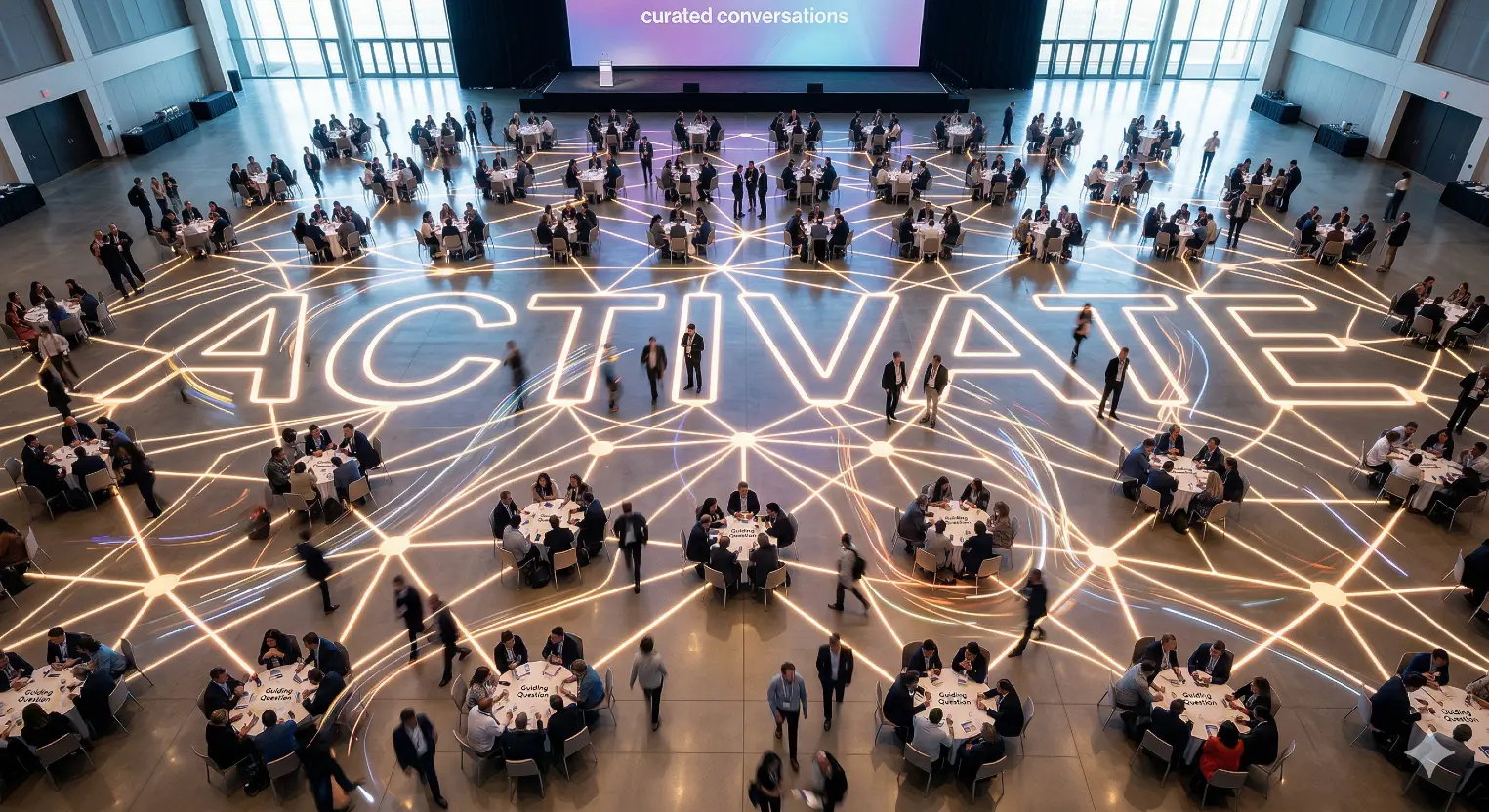
Curated Networking Activates Event Audiences
They want meaningful connections, not random mingling. They want conversations that help them solve problems, share experiences, and learn from people facing similar challenges. And increasingly, this is one of the primary reasons people attend events in the first place.
That’s why the Activate phase of our Align–Activate–Amplify (AAA) framework focuses on curated networking — intentionally designing moments where people connect in ways that are structured, relevant, and valuable.
Because when networking is thoughtfully designed, it stops being filler between sessions and becomes one of the most powerful parts of an event.
Why Networking Needs to Be Designed
Julius Solaris, one of the most respected voices in event design, has been tracking this change for years. As he puts it:
“Networking is the top reason why people attend events, yet it is still the least designed part of the experience.”
It’s a simple observation, but it changes everything.
Because if networking is the primary reason people attend, then it can’t be left to chance. Connection isn’t something that happens between sessions. In many ways, it is the session.
Most conferences still treat networking as something that happens during coffee breaks or receptions — with the assumption that meaningful conversations will naturally emerge.
But they rarely do.
Instead, many attendees leave having spoken only to the people they already knew. And in an era where content is widely available online, that becomes a missed opportunity.
Because today, people aren’t just attending to listen to speakers — they’re attending to meet each other.
The Rise of Curated Networking
Curated networking replaces passive mingling with structured, facilitated conversations that bring the right people together.
Instead of leaving interactions to chance, organizers create environments where meaningful conversations can happen naturally. These moments don’t need to be complicated. In fact, some of the most effective networking experiences are simple formats that give people a clear structure and purpose.
And once people have a reason to start talking, something interesting happens. The room becomes more energized. Conversations become more thoughtful. Attendees shift from passive listeners to active contributors.
But there’s another important shift happening as well.
Curated networking also recognizes that not everyone networks the same way.
Some people love walking into a room and introducing themselves to strangers. Others would rather… not. Some participants need structure. Others need time to think. And increasingly, thoughtful event design considers introverts, extroverts, and neurodivergent attendees alike.
Because when networking is designed intentionally, it becomes more inclusive — and more effective for everyone.
Designing Networking for Introverts, Extroverts, and Neurodivergent Attendees
Traditional networking often favors the most outgoing voices in the room. But curated networking creates space for different styles of participation.
Introverts often thrive in smaller, structured conversations where they have time to reflect and contribute thoughtfully. Peer roundtables and guided discussions give them a clear entry point into the conversation without the pressure of initiating small talk.
Extroverts, on the other hand, often enjoy movement and interaction. Open mic conversations, rotating discussions, and hosted networking sessions allow them to engage with multiple people and ideas, keeping the energy high.
Neurodivergent attendees benefit from clarity, structure, and predictability. Clearly defined formats, guiding questions, and facilitated conversations reduce uncertainty and make participation more comfortable and accessible.
When networking is designed with these differences in mind, more voices emerge. More perspectives surface. And the experience becomes richer for everyone.
In other words, curated networking isn’t just more engaging. It’s more inclusive.
Topic Tables and World Café Conversations
One of the most popular formats is the World Café model, where attendees move between small group conversations focused on specific topics.
Each table has a guiding question related to the conference theme. After a set period of time, participants rotate to a new table, building on the insights of the previous group.
This format works particularly well because it encourages participation from everyone, surfaces diverse perspectives, and creates energy and momentum in the room. It also removes one of the biggest barriers to networking — figuring out where to start.
For organizations trying to align people around a shared challenge or opportunity, World Café discussions can be incredibly powerful. Suddenly, everyone is part of the conversation, not just the people holding microphones.
Peer Roundtables
Peer roundtables are another highly effective networking structure.
Instead of informal conversation, attendees join small groups of peers who share similar roles, industries, or challenges. A facilitator introduces a discussion question and ensures everyone has a chance to contribute.
These sessions are especially valuable at leadership conferences and professional association events because participants can learn directly from the experiences of others facing similar issues. And often, something unexpected happens — people open up faster, share real challenges, and exchange practical ideas.
It’s not uncommon for attendees to report that these peer discussions were the most valuable part of the event. Not the keynote. Not the breakout session. The conversation itself.
Hosted Networking Sessions
Hosted networking sessions bring even more intention to the experience.
These structured gatherings are led by a moderator or expert host who guides conversation around a specific topic — leadership, innovation, or industry trends — while encouraging participants to share their own insights and experiences.
These sessions combine the energy of networking with the focus of a facilitated discussion, creating a space where both learning and relationship-building can happen simultaneously.
And perhaps most importantly, they make networking feel purposeful instead of performative.
Facilitated Audience Conversations
Some of the most engaging events now include facilitated audience conversations directly within mainstage sessions.
Rather than simply listening to a keynote, attendees are invited to briefly turn to the people around them and discuss a question posed by the speaker. This simple shift transforms passive audiences into active participants.
It also helps ideas travel farther, because people process and personalize what they’ve heard through conversation. And when people talk about ideas, they’re far more likely to remember — and act on — them.
Activating the Audience
When networking is designed intentionally, it does more than help people meet each other — it activates the entire audience.
Energy in the room increases. Participation grows. And attendees feel like they are part of something, not just observing it.
This is exactly what the Activate stage of the AAA framework is designed to do: create experiences where people engage, connect, and contribute.
Because when meaningful conversations happen inside an event, the impact of that event extends far beyond the stage.
And that’s when an event stops being something people attended…
…and becomes something they experienced together.
FAQs
Question: What is curated networking at events?
Answer: Curated networking is the intentional design of structured conversations that connect attendees based on shared interests, roles, or challenges. Instead of relying on random interactions, it creates meaningful opportunities for participants to engage with purpose.
Question: Why is networking important at conferences and events?
Answer: Networking is one of the primary reasons people attend events. It allows participants to exchange ideas, build relationships, and learn from others facing similar challenges—often providing value beyond the content on stage.
Question: How does curated networking improve audience engagement?
Answer: Curated networking transforms attendees from passive listeners into active participants. By giving people a clear structure and purpose for interaction, it increases energy, participation, and the overall impact of the event.
Question: What are examples of curated networking formats?
Answer: Common formats include World Café discussions, peer roundtables, hosted networking sessions, and facilitated audience conversations. These approaches create structured environments where meaningful dialogue can happen.
Question: What is World Café networking?
Answer: World Café networking is a format where participants rotate between small group discussions focused on specific topics or questions. Each group builds on the insights of the previous one, creating momentum and shared learning across the room.
Question: How do peer roundtables work at events?
Answer: Peer roundtables bring together small groups of attendees with similar roles or challenges. A facilitator guides the discussion, ensuring everyone has an opportunity to contribute and share insights.
Question: How can events be designed for introverts and different communication styles?
Answer: Curated networking considers different preferences by offering structured formats, smaller group discussions, and clear prompts. This approach creates a more inclusive environment for introverts, extroverts, and neurodivergent attendees.
Question: What is the difference between traditional networking and curated networking?
Answer: Traditional networking often relies on informal mingling, while curated networking is intentionally designed. It provides structure, purpose, and facilitation to help attendees form more meaningful and productive connections.
Question: How can event planners incorporate curated networking into their events?
Answer: Event planners can integrate curated networking by including structured discussion sessions, guided questions, rotating group formats, and facilitated conversations within the event agenda.
Question: How does curated networking support the overall event experience?
Answer: When networking is thoughtfully designed, it enhances learning, strengthens connections, and increases engagement. It helps attendees feel more involved and makes the event more memorable and impactful.
Enjoyed this post? Here are a few more ideas to help you design more engaging, connected event experiences:
The Future of Events
Re-Thinking Event Design
As events continue to evolve, one thing is becoming clear: the most impactful conferences won’t just deliver great content — they will create intentional opportunities for people to connect, share ideas, and learn from one another.
Curated networking is one of the most effective ways to activate audiences and turn passive attendance into meaningful participation.
If you’re planning a conference or leadership event and exploring speakers or formats that encourage real audience engagement, you can explore the LimeLight roster here.
Or, if you’d like to think through your upcoming event and how to design it for stronger connection and impact, we’d be happy to connect. You can reach out to start a conversation or book a discovery call.