
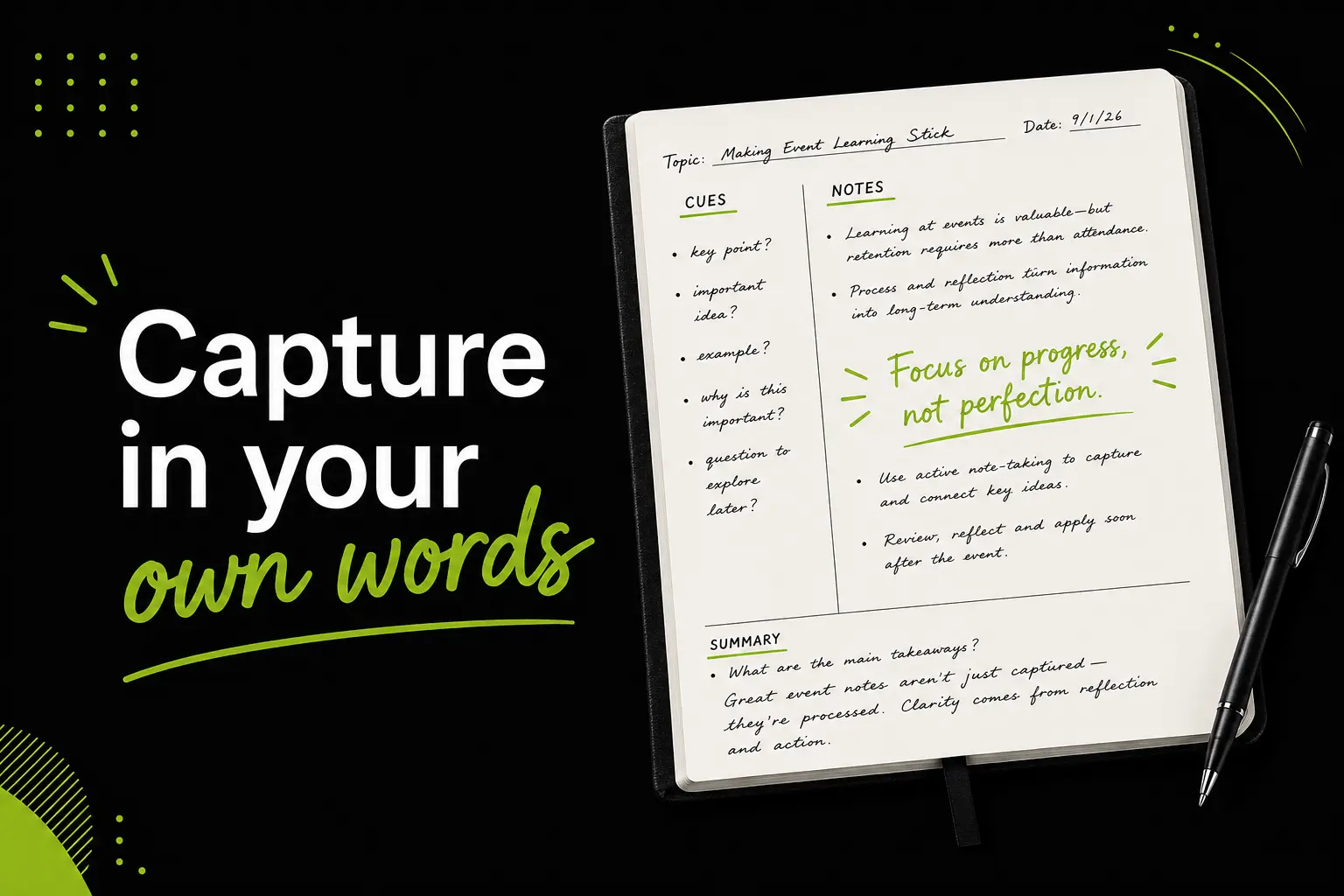
Many of us have a drawer or a shelf filled with conference notebooks. Pages of bullet points from keynotes we thought were game-changing. Words we wrote down fast enough to keep up, but not slowly enough to actually understand.
There’s a saying for this in our industry: self-development becomes shelf development.
Buying the book, filling the notebook, collecting the handouts—it feels like growth in the moment. But if it all just sits there, unopened, it isn’t.
Of course, there’s real science behind how we capture content and, more importantly, how we process it.
Event learning retention depends less on how much attendees capture and more on how actively they process what they hear.
In 2014, researchers Pam Mueller and Daniel Oppenheimer found that people who typed notes more often produced something close to word-for-word transcripts. People who wrote by hand wrote less but appeared to understand more.
The theory was compelling: handwriting forces you to think. You can’t keep pace, so you have to decide what matters and translate it into your own words. Typing removes some of that friction. Why choose what’s important when you can just get it all down and sort it out later? Except later rarely comes.
Here’s the twist. When other researchers tried to replicate those findings, the difference between handwriting and typing wasn’t nearly as clear-cut.
The bigger lesson may not really be about pens versus keyboards at all.
It’s about cognitive effort. The more actively we process information—regardless of the tool—the more likely we are to remember it.
That’s why verbatim notes can be the enemy of retention. The moment we stop processing and start transcribing, we’re doing less of the thinking that helps information stick.
Capture isn’t the problem. What happens next is.
Not everything I write down disappears.
I have a note on my iPhone that’s turned into a wonderful little collection of “Words to Live By” that I refer to often: habit hacks from James Clear, curated ideas from speakers I work with, a quote from my girlfriend Judith, countless insights from my business coach (still working on them!), my favourite quote from T.S. Eliot, and many others.
Different people, different decades, all living in the same list.
What they have in common is that I didn’t just capture them. I decided each one mattered enough to keep. That decision is the whole reason the list is worth returning to. I also love that it’s searchable. Which brings me back to events.
Think about what we typically give attendees to help them “capture” a session:
A notebook and a pen. A QR code to the slide deck. A link to the recording, promised for sometime next week.
They’re all useful capture tools. But none of them necessarily asks attendees to do the thing that really helps information stick:
Stop. Decide what matters. Put it into your own words.
So what would it look like if we designed event learning for processing, not just capture?
Here are five simple approaches I’d love to see used more often.
1. Build in a pause
Give attendees thirty seconds of quiet after a big idea lands and encourage them to write one sentence, in their own words, about what mattered most.
No elaborate prompt is needed.
The silence is the point.
It’s one of the only moments in most sessions where nobody is talking and everybody is thinking.
2. Make them say it out loud—badly
Have a facilitator ask people to turn to a fellow attendee and explain the idea they just heard in their own words.
Structured peer conversation is one way curated networking can become part of the learning experience itself.
It will be clumsy.
That’s how you know it’s working.
Explaining something imperfectly is one of the fastest ways to discover what you actually understood.
I do this myself when someone is talking about a complex idea. I think about how I’m going to explain it to someone else. Simply preparing to share the idea forces me to process it differently.
3. Replace the download with a reduction
Skip the forty-slide takeaway deck—or at least don’t make it the only takeaway.
Ask people to leave with just three big ideas instead.
Collect them on cards, a wall or in a word cloud.
Narrowing forty slides down to three ideas is part of the learning.
And let’s face it: that slide deck probably wasn’t getting reopened anyway. 😉
This instinct isn’t new. In the 1950s, education professor Walter Pauk developed what became known as the Cornell Method, a structured approach to note-taking that asks learners to return to their notes, identify key ideas and summarize what they’ve learned in their own words.
4. Ask for a prediction before giving the answer
Before a speaker reveals a surprising statistic or important conclusion, ask the audience to guess.
Write it down. Vote. Commit to an answer.
Then reveal it.
Getting the answer wrong isn’t a failure. The act of trying to retrieve or generate an answer first can make people pay closer attention to what comes next.
For an event designer, this can be incredibly simple: a show of hands, a live poll or a question from the stage can turn passive listening into active thinking.
5. Bring attendees back to the idea later—without their notes
The next morning, ask:
What is one idea from yesterday that you remember without looking at your notes?
Retrieving information from memory helps strengthen it.
And this doesn’t have to stop when the event ends.
The same principle can be used in post-event emails, team discussions, speaker follow-ups or short prompts sent days or weeks later.
This kind of spaced reinforcement is also one of the most effective ways to counter the forgetting curve and extend event impact beyond the room.
That’s where processing starts becoming amplification.
Design for Event Learning Retention — That Means Thinking, Not Just Listening
None of this needs to be complicated, expensive or a big production.
It simply needs to interrupt our reflex to transcribe.
The goal isn’t to help attendees capture more information.
It’s to help them think about the information long enough for the ideas that matter to take root.
When events are designed only for the moment itself, even great ideas can lose their impact quickly. That’s one of the reasons well-executed events can still fall short of creating lasting change.
So next time you’re planning a keynote, conference session or leadership gathering, ask:
Are we giving attendees a way to capture the content—and a way to actually process it?
We need both.
And before you leave this page, write down one idea you’ll use at your next event!
If you’re planning a conference, leadership event or organizational gathering and want to create stronger learning and lasting impact, explore the LimeLight speaker roster or contact us to book a discovery call to discuss your event strategy.
Enjoyed This Post? You Might Also Like:
FAQs
What is event learning retention?
Event learning retention is the ability of attendees to remember, understand and apply ideas after an event. It improves when participants actively process information rather than simply listening or recording what they hear.
Why do attendees forget so much after events?
Attendees often forget information because many events rely heavily on passive listening and information capture. Without opportunities to reflect, retrieve, discuss or revisit ideas, much of what was learned can quickly fade.
Does handwriting improve learning retention at events?
Handwriting may encourage people to summarize and process information rather than transcribe it word for word, but the larger lesson is that cognitive effort matters more than the specific note-taking tool.
How can event planners improve learning retention?
Event planners can improve retention by building in reflection pauses, peer discussion, idea reduction, prediction exercises and opportunities to retrieve information from memory later.
Why is active processing important for event learning?
Active processing requires attendees to decide what matters, explain ideas in their own words and connect new information to what they already know. That deeper thinking makes learning more likely to stick.
What is retrieval practice at an event?
Retrieval practice means asking attendees to recall an idea from memory without looking at their notes. Recalling information helps reinforce learning and can be used during an event or in post-event follow-up.
How does post-event reinforcement support learning retention?
Post-event reinforcement brings attendees back to key ideas through emails, discussions, speaker follow-ups or short prompts. Revisiting information over time helps strengthen memory and encourages application.
How can event organizers help attendees apply what they learn?
Organizers can help by asking attendees to identify key takeaways, explain ideas to others, choose actions they will try and revisit those commitments after the event.
Continue Exploring Intentional Event Design
- The Forgetting Curve: Why Events Need More Than a Moment
Explore why learning fades so quickly without reinforcement—and how intentional follow-through can protect event ROI. - How Curated Networking Activates Event Audiences
Discover how structured conversation helps attendees process ideas, participate more actively and build meaningful connections.