
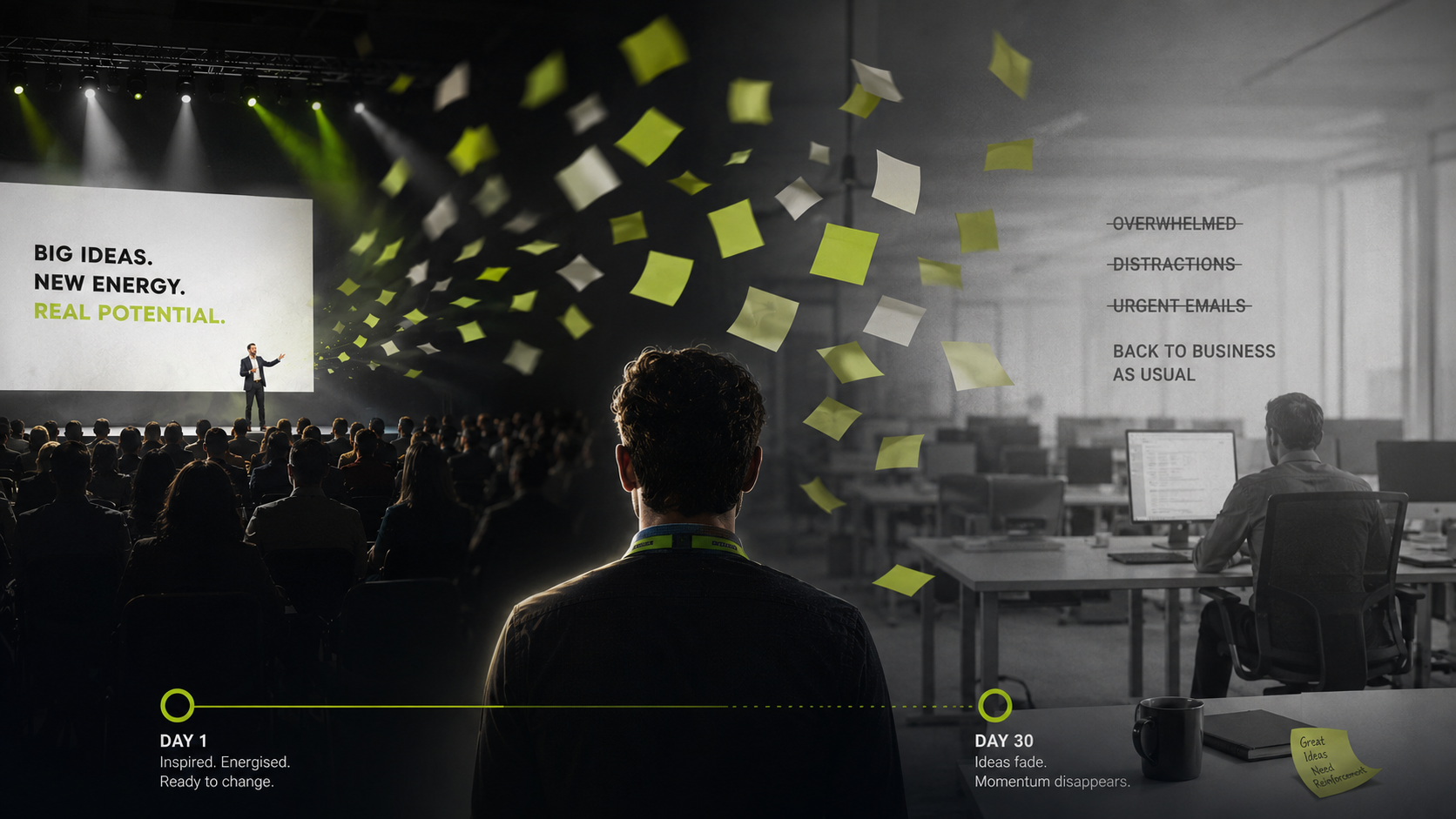
You planned everything perfectly.
The venue was right. The speakers were polished. The AV worked — mostly. Attendance was strong, the feedback forms came back positive, and the rah rah post-event email landed in everyone’s inbox before the week was out. And yet, three weeks later, nothing has changed.
No new behaviours. No breakthroughs. No measurable shift in how your team works, leads, or collaborates. Just a line item on the budget and a growing sense that you’ve been here before.
If this sounds familiar, you’re not alone — and you’re not doing it wrong. You’re doing what almost everyone does: mistaking a well-executed event for an impactful one.
They are not the same thing.
The Real Reason Most Events Underdeliver
Research shows that 83 percent of marketing and HR leaders view events as critical for organizational growth. Yet fewer than half believe those events consistently achieve their desired outcomes.
That gap — between investment and impact — isn’t a production problem. It’s a design problem.
For decades, the events industry has optimized for the wrong things: logistics, aesthetics, speaker credentials, decor, catering. These things matter, but they are not what creates lasting change. What creates lasting change is intention — clarity about why you’re gathering, who needs to feel included, and what you want people to do differently when they go home. That clarity starts with a clear event purpose—the specific change the gathering is intended to create.
Most events are designed as one-time information downloads. A keynote here, a panel there, a cocktail reception to close. The content may be excellent. The energy may be high. But without a strategic architecture that engages people before, during, and after the gathering, the investment evaporates within days.
Neuroscience tells us why: our brains prioritize repetition and emotion. We retain what we revisit — and what genuinely moves us. A single inspiring moment, no matter how well delivered, isn’t enough to rewire behaviour or shift culture.
The Cost of Planning Without Pause
Here’s a pattern that plays out in organizations everywhere.
The event ends. The applause fades. The team exhales — briefly — and then the next planning cycle begins at full speed. No debrief. No reflection. No real examination of what worked, what didn’t, and what could have created more lasting impact.
Sprint. Execute. Collapse. Repeat.
This isn’t just exhausting. It’s expensive. Organizations spend thousands — sometimes millions — on gatherings that are flawlessly produced yet rarely examined. Without an intentional pause between cycles, the same patterns repeat: rushed agendas, unclear purpose, and events that aim for inspiration but fall short of transformation.
The industry’s blind spot isn’t production quality. It’s the absence of deliberate design.
What Intentional Gathering Actually Means
Intentional Gathering is not a new buzzword. It’s a fundamentally different way of thinking about why and how organizations bring people together.
The concept builds on Priya Parker’s foundational insight in The Art of Gathering — that every meeting should begin with clarity of purpose and a genuine sense of belonging — and extends it into a practical operating model.
At LimeLight Group, we call that model the Align–Activate–Amplify Framework:
Align means beginning with purpose. Before a single slide is built or stage is set, you answer the question why are we gathering? — and you co-create that answer with the people who will be in the room. Alignment primes minds and builds emotional investment before anyone arrives.
Activate means designing an experience that engages hearts and minds, not just fills seats. Participation, storytelling, structured connection, and intentional emotion aren’t extras — they’re the mechanisms through which learning actually happens.
Amplify means extending impact beyond the event itself. What happens after the gathering matters as much as what happens during it. Reinforcement, community, measurement, and follow-through are what separate a moment from a movement.
This isn’t event planning. It’s experience architecture — the deliberate design of gatherings that produce outcomes you can measure, outcomes that endure.
The Shift That Changes Everything
The most powerful reframe in modern event design is this: stop treating events as moments to manage and start designing them as experiences to co-create, amplify, and share.
That one shift changes everything downstream. It changes how you brief speakers. How you structure your agenda. How you measure success. How you define value for your stakeholders.
It also changes what people walk away with — not just notes and a tote bag, but a genuine shift in perspective, connection, or commitment.
The world doesn’t need more events. It needs more meaningful ones.
If your gatherings aren’t producing the outcomes you’re investing in, the answer isn’t a bigger budget or a flashier production. It’s a more intentional design.
LimeLight Group helps organizations gather with intention and impact. We partner with forward-thinking associations and companies to design speaker-led experiences that align audiences, activate ideas, and amplify measurable results long after the meeting ends. Ready to reimagine your next gathering? Let’s talk.
Frequently Asked Questions
Question: What is intentional gathering?
Answer: Intentional gathering is the practice of designing events with clarity of purpose, meaningful participation, and measurable outcomes in mind. Rather than focusing only on logistics and production, intentional gathering emphasizes creating experiences that engage people before, during, and after an event to drive lasting impact.
Question: Why do events fail to create lasting impact?
Answer: Events often fail to create lasting impact because organizations focus heavily on production elements such as logistics, speakers, and execution without designing experiences that reinforce learning and engagement over time. Lasting change requires intentional design, participation, repetition, emotional connection, and follow-through beyond the event itself.
Question: How can organizations design more meaningful events?
Answer: Organizations can create more meaningful events by starting with a clear purpose, designing opportunities for participation and connection, and extending learning beyond the gathering itself. Strategic event design considers how people engage before, during, and after an event to create stronger outcomes and lasting impact.
Question: What is experience architecture in event planning?
Answer: Experience architecture is the deliberate design of event experiences that produce measurable outcomes. It moves beyond traditional event planning by focusing not only on logistics and content delivery, but also on engagement, participation, emotional connection, and reinforcement that extends beyond the event.
Question: Why is audience engagement important at events?
Answer: Audience engagement helps transform participants from passive attendees into active contributors. When people are engaged through participation, storytelling, structured connection, and shared experiences, they are more likely to retain information, build connections, and apply what they learned after the event ends.
Question: What is the Align–Activate–Amplify framework?
Answer: The Align–Activate–Amplify framework is LimeLight Group’s approach to intentional event design. Align focuses on creating clarity of purpose before an event begins. Activate centers on designing engaging experiences that involve participants emotionally and intellectually. Amplify extends learning and momentum beyond the gathering to strengthen long-term impact.
Question: How do organizations measure event impact?
Answer: Event impact can be measured by looking beyond attendance numbers and satisfaction surveys to evaluate outcomes such as engagement, behavioural change, learning retention, connection, and progress toward organizational goals. Meaningful measurement focuses on what changes after the event ends.
Question: What makes an event successful beyond attendance?
Answer: Successful events create meaningful experiences that influence thinking, strengthen connections, and inspire action. While attendance and logistics matter, long-term impact comes from intentional design, audience engagement, and creating experiences that continue generating value long after the event concludes.
Enjoyed this post? Explore more ideas shaping the future of intentional event design:
The Future of Events
Re-Thinking Event Design
The most impactful events don’t happen by accident. They are intentionally designed to align people, activate ideas, and create momentum that lasts long after the gathering ends.
If you’re planning a conference, leadership event, or organizational gathering and exploring how to create stronger engagement and measurable impact, explore the LimeLight roster here.
Or, if you’d like to think through your upcoming event strategy, we’d be happy to connect. Book a discovery call and let’s explore what’s possible.