
Picture this. You’ve just wrapped a three-day conference. Half a million dollars invested. World-class speakers. A packed ballroom full of people who were genuinely engaged, genuinely inspired, and genuinely ready to do things differently.
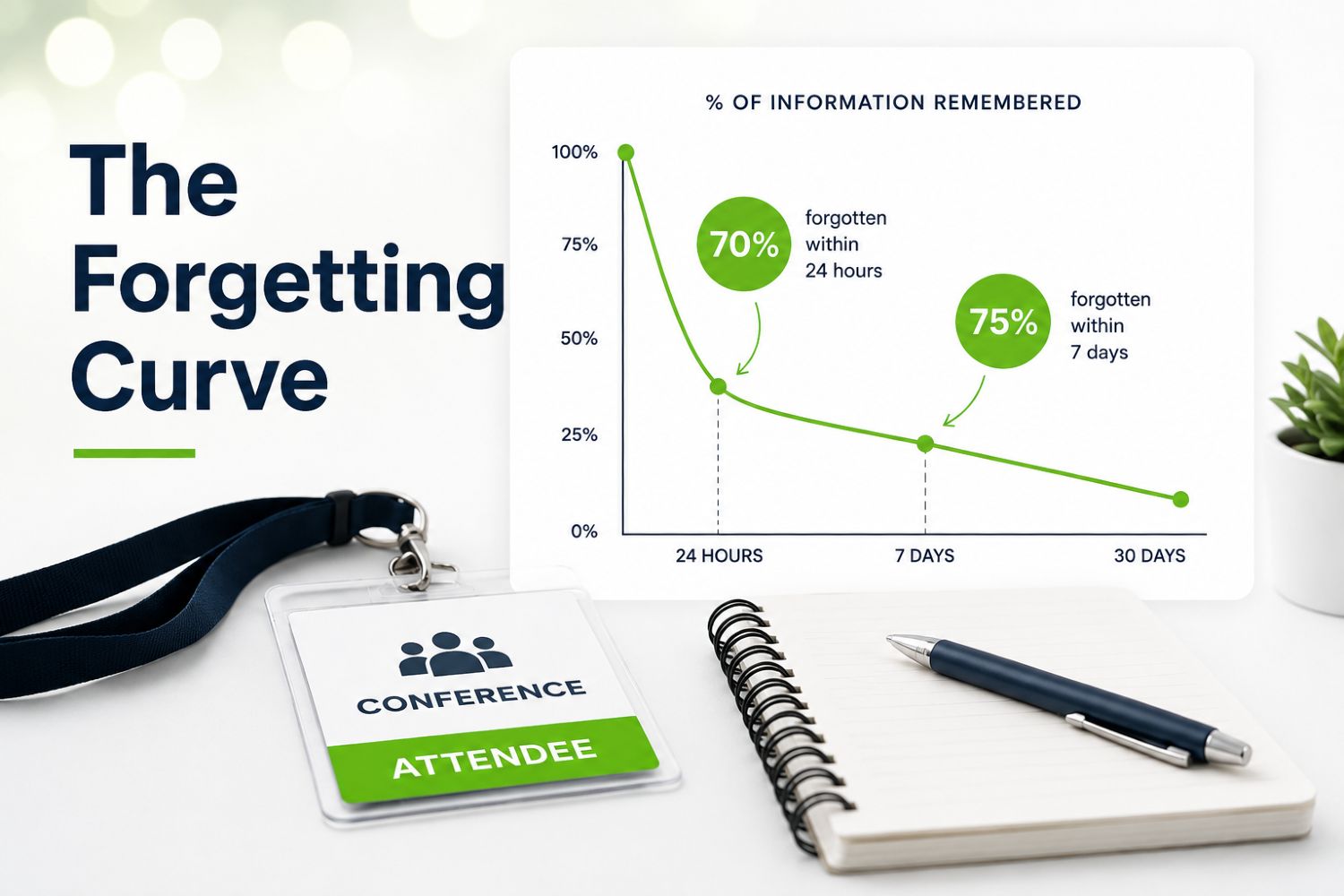
People forget up to 70% of new information within 24 hours — and 75% within a week — without reinforcement.
Not misplaced. Not half-remembered. Gone.
This isn’t a worst-case scenario. This is what the science says happens when we design events as one-time experiences with no follow-through — and it’s costing organizations far more than they realize. Defining a clear event purpose up front also helps determine what needs to be reinforced afterward, because you know exactly what change the event is meant to support.
What Is the Forgetting Curve — and Why Should Event Planners Care?
In the 1880s, German psychologist Hermann Ebbinghaus mapped something that should make every event professional a little uncomfortable: without reinforcement, people lose up to 80 percent of new information within a week.
He called it the forgetting curve, and more than a century of neuroscience has confirmed it. Our brains aren’t built to retain information from a single exposure. We retain what we revisit — what’s repeated, applied, or emotionally anchored.
For the events industry, the implications are hard to ignore.
Research from the ATD (Association for Talent Development) found that only 12 percent of employees apply new skills from training programs without post-event reinforcement — and that number doesn’t improve just because the training was delivered at a live event.
That means 88 percent of potential impact and the behaviour change, the culture shift you were hoping to spark quietly disappears. Not because the content wasn’t good. Because the design stopped too soon.
The Real Cost of Forgetting
Let’s make this concrete.
An annual leadership retreat could cost $400,000 to produce — a realistic budget for 200 people over multiple days in a major Canadian city, once you factor in venue, catering, AV, speakers, and staff time. Your keynote speaker challenges the room to rethink how they lead. Your workshop facilitator helps people build a new framework for collaboration. The energy is electric.
And then everyone goes home to overflowing inboxes, competing priorities, and the relentless pace of regular life.
If post-event reinforcement isn’t built into the design, research suggests that most of what was shared will be functionally forgotten before the month is out. The event itself isn’t the problem. The design is — specifically, the assumption that impact ends when the applause does.
Why Traditional Events Are Designed for Forgetting
Most events are structured as information deliveries: a series of sessions, back to back, where content is presented and attendees are expected to absorb it. The format is familiar. It’s also neurologically backwards.
Human memory isn’t a recording device. It’s a reconstruction system that prioritizes information that is revisited, emotionally significant, or tied to action.
When we design events as one-time downloads with no follow-through, we are — in effect — designing for forgetting. The good news is that the forgetting curve is not destiny. Cognitive science and adult-learning research point to practices that dramatically improve retention, and none of them require a bigger budget.
Four Science-Backed Strategies That Flatten the Forgetting Curve
1. Pre-framing: Create mental hooks before the event begins
People remember more when they understand why an experience matters before it happens. A short pre-event video from your keynote speaker, a single reflection question sent in advance, or a brief survey asking “What challenge do you most need to solve?” — these small acts of alignment create cognitive anchors that make new information stick.
2. Active participation: Replace passive listening with contribution
Engagement doubles when learning is participatory. Even thirty seconds of reflection time after a keynote can meaningfully improve retention. Discussion, collaborative problem-solving, live polling, and structured peer conversation all activate the brain in ways that passive listening simply cannot.
Worth noting: our brains are twenty-two times more likely to remember information when it’s delivered as a story rather than as facts alone. The most effective event speakers aren’t presenters — they’re storytellers.
3. Emotional connection: Make it matter
We remember what moves us. Humour, surprise, vulnerability, shared pride — these aren’t entertainment add-ons. They are memory mechanisms. Events designed to evoke genuine emotion create the neural pathways that make ideas far more likely to stick and be acted on.
4. Spaced reinforcement: Extend the experience beyond the event
This is the most underused strategy in events, and honestly, the most powerful. Revisiting ideas after time has passed — what educators call spaced reinforcement — can improve retention by 200 to 300 percent. A single well-timed reminder, sent ten days after an event, can reignite motivation and recall in ways that in-room repetition cannot.
In practice, this might look like:
- A “Top 5 Insights” summary sent within days of the event
- Weekly micro-learning touchpoints for 30 to 60 days post-event
- Short video recaps from speakers paired with a reflection question
- A peer community channel where attendees share progress and wins
- A post-event Q&A session 30 days out to surface what’s actually been applied
None of these are expensive. All of them are transformative.
Rethinking What Event Success Looks Like
If your current measure of event success is attendance numbers and satisfaction scores, you’re measuring the wrong things — and you’re not alone. Most organizations are.
Satisfaction tells you whether people enjoyed the experience. It doesn’t tell you whether anything changed. The more important question — the one most organizations never think to ask — is: What did people do differently because we gathered?
At LimeLight Group, we call this Return on Impact. It’s a shift from measuring popularity to measuring progress. Questions like “How much has this experience improved your ability to lead or collaborate?” and “What one idea have you implemented since attending?” give you visibility into transformation, not just satisfaction.
These questions don’t just produce better data. They reinforce learning in the very act of answering them.
The Bottom Line
The forgetting curve is real, and it’s quietly eroding the value of your events investment.
But it is not inevitable. When organizations design gatherings with intention — with pre-framing, active participation, emotional resonance, and structured follow-through — they transform events from moments of inspiration into engines of sustained change.
The applause fades. The inboxes fill. Life resumes. What happens next is entirely a design choice.
LimeLight Group helps organizations design speaker-led events that produce measurable, lasting impact. We build the Align–Activate–Amplify Framework into every gathering we touch — before, during, and after the event. Let’s design something that lasts.
Frequently Asked Questions
What is the forgetting curve?
The forgetting curve is a concept developed by psychologist Hermann Ebbinghaus that explains how quickly people forget newly learned information without reinforcement. Research shows that most information is lost within days unless it is reviewed, applied, or reinforced over time.
Why is the forgetting curve important for event planners?
The forgetting curve highlights why great presentations alone rarely create lasting change. Without intentional follow-up and reinforcement, attendees quickly forget key insights, reducing the long-term impact of conferences, meetings, and leadership events.
How can event planners improve learning retention?
Event planners can improve retention by incorporating pre-event preparation, active audience participation, emotional storytelling, and post-event reinforcement such as follow-up resources, discussion groups, and reflection activities.
What is post-event reinforcement?
Post-event reinforcement is the practice of revisiting important ideas after an event through emails, videos, coaching, peer discussions, or learning activities. Reinforcement helps attendees remember and apply what they learned long after the event ends.
Why doesn’t inspiration create lasting behaviour change?
Inspiration creates motivation in the moment, but lasting behaviour change requires repetition, practice, emotional connection, and opportunities to apply new ideas. Without reinforcement, even inspiring experiences are quickly forgotten.
What is Return on Impact?
Return on Impact is LimeLight Group’s approach to measuring event success by evaluating what changes after an event. Rather than focusing only on attendance or satisfaction scores, it measures learning, engagement, behaviour change, and organizational outcomes.
What is the Align–Activate–Amplify Framework?
The Align–Activate–Amplify Framework is LimeLight Group’s event design model. It aligns participants around a shared purpose before the event, activates engagement during the experience, and amplifies learning through structured follow-up and reinforcement afterward.
How can organizations create events with lasting impact?
Organizations create lasting impact by designing events that combine purposeful planning, active participation, emotional connection, and ongoing reinforcement. This approach helps ideas become lasting actions rather than short-lived inspiration.
Enjoyed this post? Explore more ideas shaping the future of intentional event design:
The Future of Events
Why Events Fail (And How to Design Gatherings That Create Lasting Change)
The most impactful events don’t happen by accident. They are intentionally designed to align people, activate ideas, and create momentum that lasts long after the gathering ends.
If you’re planning a conference, leadership event, or organizational gathering and exploring how to create stronger engagement and measurable impact, explore the LimeLight roster here.
Or, if you’d like to think through your upcoming event strategy, we’d be happy to connect. Book a discovery call and let’s explore what’s possible.